Choosing the Right Marketing Ads Model for Your 2026 Growth Strategy
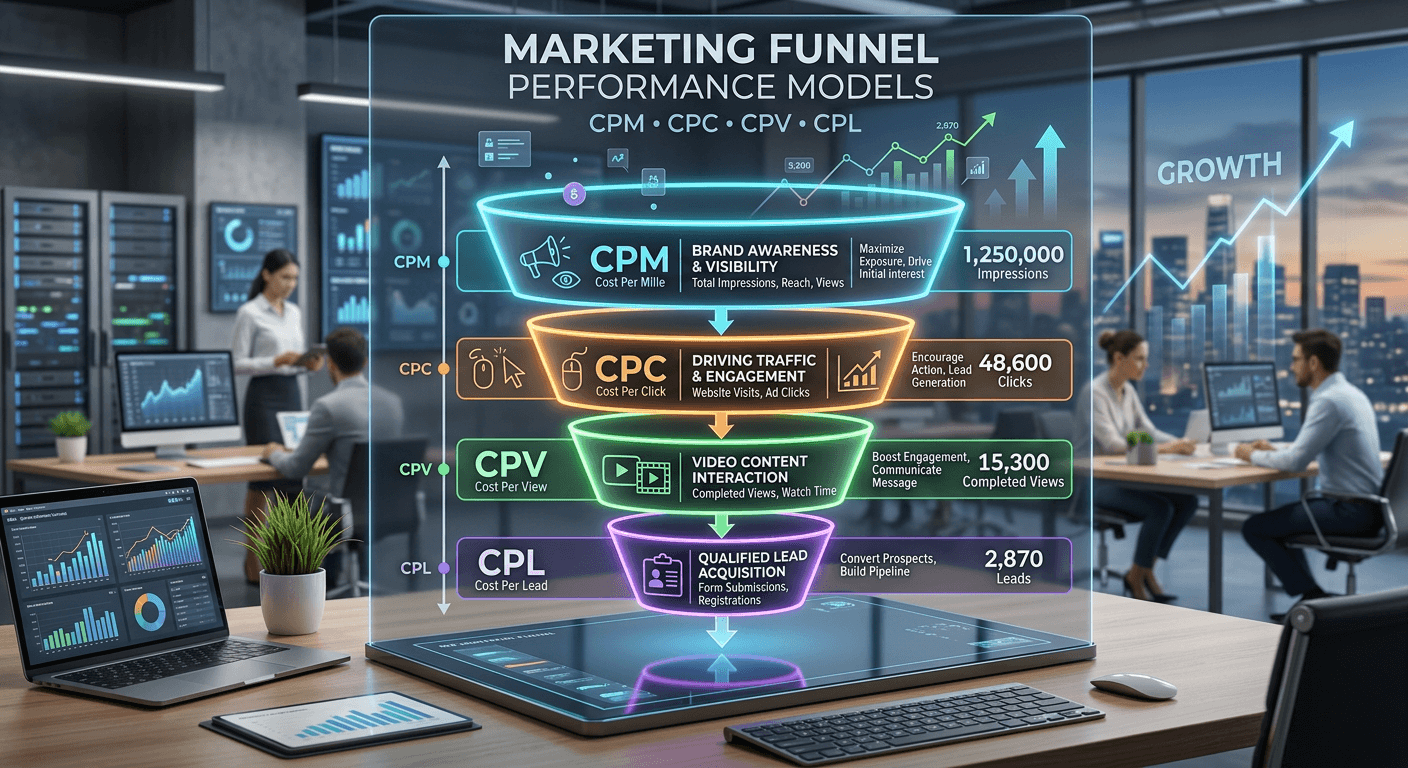
Selecting the most effective advertising model is a foundational step for any business looking to optimize its budget and drive measurable outcomes. In a digital landscape dominated by diverse pricing structures, understanding the nuances of how you pay for exposure versus action is critical to maintaining a healthy return on investment. Whether you are aiming for broad brand awareness or hyper-targeted lead acquisition, aligning your chosen metrics with your specific business goals is essential for sustained growth.
Quick Summary
Marketing ads models define the financial basis upon which companies purchase digital media, typically categorized by the action required by the user. Choosing the right model depends on whether the primary goal is brand visibility, website traffic, or direct conversion.
- CPM focuses on reach and brand awareness through impressions.
- CPC is the standard for driving qualified traffic to landing pages.
- CPV is tailored for video content engagement and brand storytelling.
- CPL emphasizes lead acquisition by paying only for verified prospect information.
Table of Contents
- Comparison of Marketing Ads Models
- CPM Marketing: Paying for Impressions
- CPC Marketing: Paying for Click-Throughs
- CPV Marketing: Paying for Video Engagement
- CPL Marketing: Paying for Qualified Leads
- How to Choose the Right Model for Your Business
- FAQ
- Recommended Reads

Comparison of Marketing Ads Models
| Model | Primary Metric | Best For | Main Advantage | Main Risk |
|---|---|---|---|---|
| CPM | 1,000 Impressions | Brand Awareness | Low barrier to entry | No guarantee of traffic |
| CPC | Per Click | Driving Traffic | High intent alignment | Click fraud potential |
| CPV | Per View | Video Storytelling | Engaged audience | High production cost |
| CPL | Per Lead | Sales Pipeline | ROI clarity | Strict verification needed |
CPM Marketing: Paying for Impressions
CPM marketing, or Cost Per Mille (cost per thousand impressions), is the oldest and most straightforward model in digital advertising. In this setup, advertisers pay a fixed fee for every 1,000 times their ad is displayed to a user, regardless of whether that user interacts with the ad or clicks on it. This model is ideal for top-of-funnel campaigns where the primary objective is to increase brand recognition and saturate a specific market segment.
Because CPM does not rely on user action, it is highly scalable and allows for rapid distribution across large networks. For businesses focused on hyper-local SEO and regional dominance, CPM can be an effective way to establish brand presence across a city or state. However, it requires careful audience segmentation to ensure those impressions are being delivered to the right demographics, as the cost can accumulate quickly without a direct performance guarantee.
CPC Marketing: Paying for Click-Throughs
CPC marketing, or Cost Per Click, shifts the financial burden from exposure to intent. Under this model, an advertiser pays only when a user actually clicks on the advertisement. This is widely considered the industry standard for performance marketing because it ensures that the business is only paying for users who have demonstrated enough interest to visit the company website, which aligns with https://rapidwombat.br.com/terms for transparent service delivery.
This model is inherently safer for smaller budgets where wasted exposure can lead to rapid capital depletion. By monitoring the cost per click against the eventual conversion rate, businesses can calculate their customer acquisition cost with high precision. It is the preferred choice for search engine advertising and social media campaigns where the objective is to guide the user through a clear https://rapidwombat.br.com funnel toward a conversion goal.
CPV Marketing: Paying for Video Engagement
CPV marketing, or Cost Per View, is specifically designed for video content platforms. An advertiser pays when a user watches a specified duration of their video ad or interacts with the call-to-action overlay. This model is exceptionally effective for brand storytelling, as it forces the advertiser to produce high-quality, engaging content that captures attention within the first few seconds of playback.
CPV campaigns thrive in environments where visual demonstration is crucial, such as showcasing technical services or explaining complex service packages. Since users are often given the option to skip ads after a few seconds, the CPV metric effectively acts as a filter for audience interest. If a user watches the entire ad, it signals a deeper level of engagement that is difficult to achieve through static banner ads.
CPL Marketing: Paying for Qualified Leads
CPL marketing, or Cost Per Lead, is the most results-oriented model on this list. Instead of paying for traffic or views, the advertiser pays only when a user performs a specific action, such as filling out a contact form, requesting a demo, or subscribing to a newsletter. This model effectively offloads the risk of low conversion rates from the advertiser to the publisher or platform.
CPL is highly effective for B2B enterprises or service-based businesses that require verified contact data to sustain their sales pipeline. Because the cost per lead can be significantly higher than a standard CPC or CPM, this model requires a robust https://rapidwombat.br.com/privacy and lead nurturing process to ensure that the cost incurred leads to a high customer lifetime value.
How to Choose the Right Model for Your Business
Choosing the right model involves analyzing your current business stage and your specific goals for a campaign. If you are launching a brand in a new territory, CPM allows for broad, cost-effective reach. If you are operating in a competitive space where every visitor is valuable, CPC provides the necessary control to ensure traffic quality while minimizing waste.
For businesses with high-ticket offerings or complex sales cycles, CPL is the most logical choice as it ties your marketing expenditure directly to the expansion of your prospect list. Evaluate your historical data to see which metrics historically lead to revenue; if your funnel is currently leaking at the landing page stage, focus on high-quality traffic via CPC. If your funnel is strong but lacks volume, prioritize CPM to drive brand awareness.
FAQ
Which advertising model is best for small businesses?
Small businesses typically benefit most from CPC marketing, as it ensures that advertising spend is directly correlated with website traffic, minimizing the risk of paying for ineffective impressions.
Can I use multiple models at the same time?
Yes, a balanced media mix is recommended. Many businesses use CPM for brand awareness, then retarget those individuals using CPC or CPL models to drive specific conversions.
How does video advertising differ from static ads in pricing?
Video advertising often uses CPV, which measures engagement beyond a simple click, reflecting the higher production value and attention requirement of video content.