From Marketing 2.0 to Autonomous Systems: How to Adapt to Modern Strategy Benchmarks
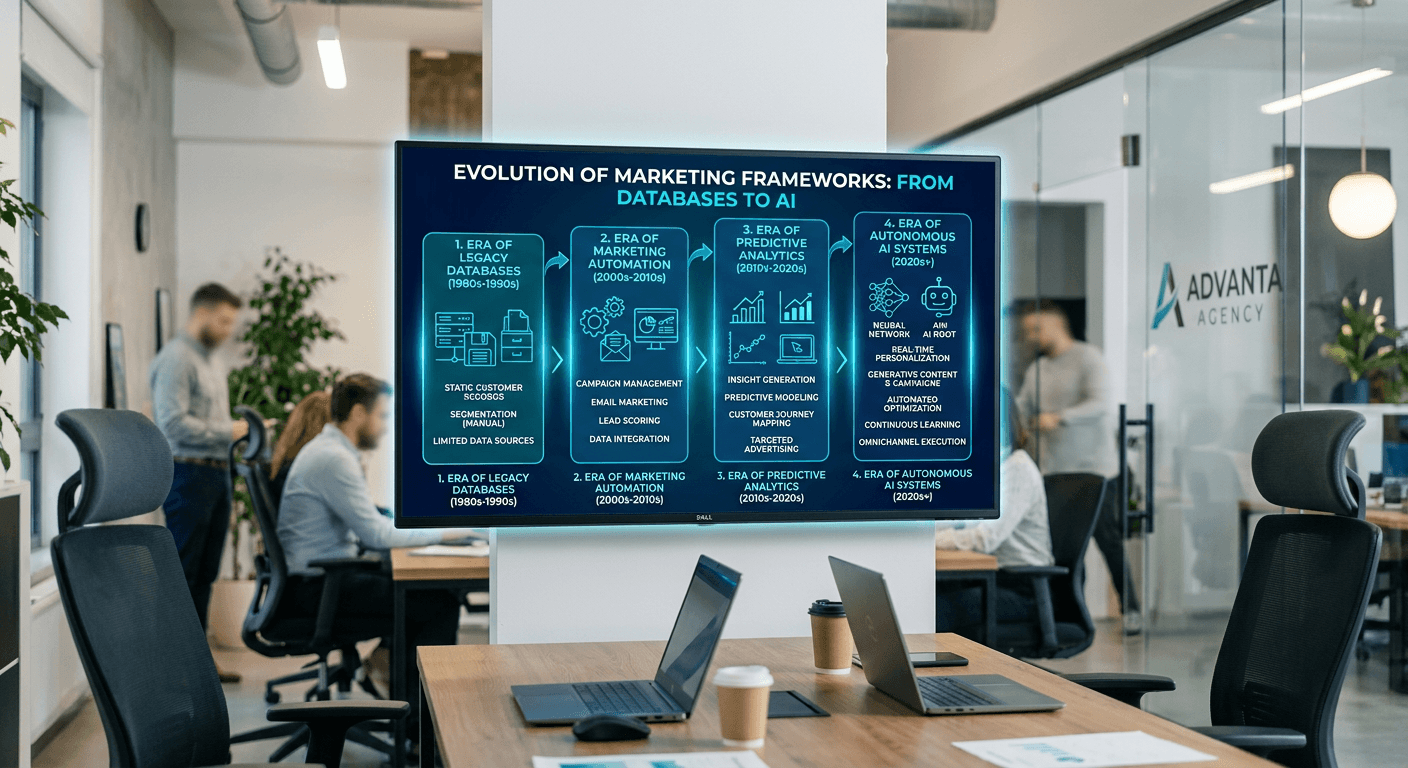
The assumption that modern business requires abandoning legacy marketing frameworks is a costly mistake. Many operational teams treat the transition from consumer-centric marketing 2.0 to highly automated, AI-driven ecosystems as a simple software upgrade, only to realize their data pipelines cannot support the weight of real-time personalization. Navigating these conceptual transitions requires more than installing new marketing tools; it demands a clear understanding of how each marketing generation operates structurally. To scale effectively, businesses must evaluate where their operational workflows fit within the technological evolution of customer acquisition.
Quick Summary
The evolution of marketing models spans from basic, relational customer segmentation to complex, autonomous virtual ecosystems. Transitioning through these models requires upgrading strategic technology while maintaining strict compliance with evolving data-handling regulations.
- Incremental Progression: Organizations cannot successfully deploy automated predictive models without first establishing robust consumer-centric segmentation.
- Data Compliance: Modern personal profiling requires structured consent systems that satisfy strict regional regulations like the Brazilian LGPD.
- Infrastructure Dependencies: Real-time digital campaigns fail if regional hosting networks cannot support low latency delivery.
- Agentic Shift: Emerging strategies are shifting focus from human-centric engagement to programmatic optimization for autonomous AI buyers.
Table of Contents
- Evaluating Evolutionary Milestones from Marketing 2.0 Onward
- 1. Marketing 2.0: The Consumer-Centric Model
- 2. Marketing 3.0: The Values-Driven Strategy
- 3. Marketing 4.0: The Omnichannel Transition
- 4. Marketing 5.0: Data-Driven Personalization
- 5. Marketing 6.0: The Immersive Metamarketing Shift
- 6. Marketing 7.0: Autonomous Agentic Networks
- Tactical Comparison of Marketing Eras
- Mapping Your Modern Marketing Architecture
- FAQ
- Recommended Reads
Evaluating Evolutionary Milestones from Marketing 2.0 Onward
Evaluating the evolution of marketing requires analyzing two key metrics: consumer autonomy and data depth. As these metrics scale, the operational requirements of marketing departments shift from simple message creation to complex infrastructure management.
Consumer autonomy measures how much control a buyer has over their own discovery and purchase path. Data depth refers to the granularity of information used to influence that path - moving from basic group demographics to real-time spatial and psychological profiles. If an organization tries to run high-level personalized automation on top of a messy, offline data stack, the entire campaign collapses under the weight of inaccurate targeting. Understanding the distinct layers of each model is the only way to avoid this structural misalignment.
1. Marketing 2.0: The Consumer-Centric Model
This framework is built for businesses moving away from transactional mass production to targeted, database-driven customer relationships. It targets brand managers and product marketing teams who must justify campaigns through specific audience segmentation rather than blind, mass-market broadcasts.
This model works by building static demographic and behavioral profiles to divide a broad audience into distinct customer segments. Instead of broadcasting a single message to all of Brazil, a regional brand segments its market, offering premium service tiers to corporate professionals in São Paulo while pitching cost-effective packages to small merchants in Paraná. This is achieved using relational databases, basic CRM systems, and email lists to track past purchase history and tailor messaging to specific cohorts.
Relational segmentation that fails to capture real-time dynamic behavior
This model is fundamentally static. It assumes consumer preferences remain stable between quarterly database updates, making it useless for real-time digital ecosystems. If your business depends on instant local intent - such as matching a user's sudden search for a nearby repair shop - relying strictly on static demographic buckets will cause you to miss high-intent traffic entirely. Skip this as a standalone strategy if your audience interacts across multiple fast-moving digital channels where real-time behavior overrides historical profiles.
2. Marketing 3.0: The Values-Driven Strategy
This purpose-driven framework connects with consumers on a cognitive, emotional, and ethical level. It is built for companies operating in highly competitive markets where functional differentiation is no longer enough to retain client loyalty.
This model embeds social, environmental, and ethical values directly into the corporate identity. Instead of just highlighting product specifications, the brand aligns its narrative with broader societal issues - such as sustainable sourcing, local economic empowerment, or transparent supply chains. Operationally, this requires integrating corporate social responsibility (CSR) into product design, employee relations, and public relations, ensuring the brand's actions match its messaging across public channels.
Human-centric positioning that collapses under shallow corporate execution
Consumers have developed highly sensitive radar for superficial posturing. If you claim to support regional development but route your operational profits through tax havens or exploit local workers, public exposure will damage your brand reputation. It is also poorly suited for strictly transactional, low-margin B2B products where buying decisions are governed solely by procurement price sheets. Do not invest in this model if your operational foundation cannot withstand aggressive public audit.
3. Marketing 4.0: The Omnichannel Transition
This transitional framework bridges physical and digital spaces. It is designed for brick-and-mortar retailers, regional distributors, and traditional service providers who must unify their physical presence with online customer journeys.
The framework, widely explored as marketing 4.0 kotler, maps the non-linear customer path from initial awareness to ultimate advocacy. This journey is tracked across the classic "5 A's" framework: Aware, Appeal, Ask, Act, and Advocate. It integrates offline interactions - like visiting a storefront in Belo Horizonte - with digital actions like searching for local reviews, scanning QR codes, and completing transactions via mobile apps. It relies on unified databases that link physical store visits with online user profiles to ensure a seamless transition.
Unified customer pathways that fracture across disjointed inventory networks
This model breaks down when internal organizational silos remain unaddressed. If your physical retail staff operates on a different inventory and compensation system than your e-commerce division, they will actively work against each other, leading to broken promises, split orders, and frustrated customers. It also demands high upkeep costs to keep physical and digital customer profiles synchronized. If your business lacks the technical capacity to merge inventory and sales data in real time, the omnichannel promise quickly turns into an operational nightmare.
4. Marketing 5.0: Data-Driven Personalization
This framework pairs data processing with human interaction, designed for high-velocity digital brands and enterprise agencies managing complex customer lifecycles.
This model deploys data-driven technology to mimic human-centric experiences at scale. It utilizes predictive analytics, natural language processing, and agile marketing workflows to anticipate customer needs before they are explicitly stated. For example, by analyzing regional search behaviors, an automated engine can dynamically serve highly customized landing pages to users across different states, shifting the content based on weather, local holidays, or real-time regional economic conditions.
Practical rule: Never deploy predictive analytics or dynamic behavioral tracking until you have mapped your user data pipelines to meet local regulatory guidelines. A highly personalized campaign that triggers an audit under compliance laws like LGPD will cost far more in legal penalties than it generates in conversion lift.
Hyper-targeted delivery systems that run directly into strict compliance barriers
It is exceptionally vulnerable to regulatory enforcement. In markets operating under strict data protection laws, such as the Brazilian LGPD, collecting and processing the deep behavioral data required for this model carries massive compliance risks. If your system tracks users across multiple sessions without explicit, audited consent, you risk heavy fines and brand blacklisting. Implementing a compliant regional SEO platform helps mitigate these risks, but this model should still be avoided by organizations that do not have a robust, compliant infrastructure capable of managing user consent transparently.
5. Marketing 6.0: The Immersive Metamarketing Shift
This spatial marketing framework is designed for lifestyle, entertainment, and high-engagement consumer brands looking to bridge physical and virtual realities.
It operates by blending physical spaces with digital layers - such as augmented reality (AR), virtual reality (VR), and spatial computing - to create interactive brand experiences. Instead of reading a static catalog, a customer can project a three-dimensional product model directly into their living room or navigate a virtual store environment. This requires highly sophisticated rendering pipelines and real-time spatial positioning systems to deliver a seamless experience.
High-fidelity spatial interactions that break under network latency bottlenecks
It is highly dependent on local physical infrastructure. If your audience is accessing your interactive virtual store in an area with high network latency or spotty mobile coverage, the experience will stutter, crash, or fail to load, driving potential buyers away in frustration. This makes it highly impractical for mass-market campaigns targeting regions with undeveloped digital networks. If your conversion pipeline cannot guarantee sub-50ms response times for asset delivery, stick to lighter, more accessible digital models.
6. Marketing 7.0: Autonomous Agentic Networks
This emerging marketing ecosystem operates where systems make decisions, negotiate transactions, and manage lifecycles autonomously. It is designed for forward-looking tech enterprises, highly automated e-commerce networks, and complex digital platforms.
It works by deploying autonomous AI agents that operate independently on behalf of both the business and the consumer. In this model, a brand's system does not market to a human browser; instead, it communicates directly with the consumer's personal AI buyer assistant. The two machines negotiate price, verify delivery terms, match product specifications against preferences, and complete the transaction without direct human intervention. This relies on secure, real-time API integrations, semantic search engines, and decentralized data ledgers.
Practical rule: To prepare for an agentic future, stop optimizing solely for human eyeballs and start structuring your digital assets - like product schemas, technical specs, and local presence data - so they can be easily parsed by autonomous AI systems.
Programmatic buyer-agent connections that strip away emotional brand equity
It is entirely untested for emotional loyalty. If a machine is making purchasing decisions based purely on mathematical optimization and programmatic rules, typical brand assets like visual identity, emotional storytelling, and heritage become largely irrelevant. Your entire brand is reduced to a set of APIs and raw performance metrics. If you cannot deliver the exact technical specifications required by an agentic parser, your product will be filtered out instantly, leaving you with zero visibility.
Tactical Comparison of Marketing Eras
| Marketing Model | Primary Strategic Focus | Core Technological Enabler | Primary Execution Channels | Compliance & Infrastructure Risk |
|---|---|---|---|---|
| Marketing 2.0 | Customer Segmentation | Relational CRM Databases | Email, Direct Mail, Early Web | Low - relies on basic database consent |
| Marketing 3.0 | Values-Driven Alignment | Corporate Social Platforms | PR, Social Media, Content Hubs | Low - focused on brand positioning |
| Marketing 4.0 | Omnichannel Integration | Customer Data Platforms (CDPs) | Integrated Web, Mobile, Retail | Medium - requires unified data streams |
| Marketing 5.0 | Tech-for-Humanity Scale | Predictive Analytics & AI | Dynamic Search, Live Web | High - strictly governed by LGPD laws |
| Marketing 6.0 | Spatial Experiences | Spatial Computing & AR/VR | Virtual Worlds, Spatial Overlays | High - requires low-latency networks |
| Marketing 7.0 | Agentic Optimization | AI Autonomous Agents | Machine-to-Machine APIs | Extreme - demands secure API protocols |
Mapping Your Modern Marketing Architecture
Choosing the right framework requires aligning your technology budget with your operational bottlenecks rather than chasing modern buzzwords.
If your current bottleneck is fragmented customer data and siloed regional offices, do not try to build an immersive virtual reality showroom (Marketing 6.0). Instead, focus your energy on consolidating your customer data platforms and physical storefronts (Marketing 4.0). Ensuring that a customer profile created in Porto Alegre is instantly accessible to a service team in Recife will yield far higher operational returns than an experimental spatial computing app.
If your bottleneck is high-volume customer acquisition in crowded local markets, shift your focus toward automated, hyper-local personalization (Marketing 5.0). This requires using low-latency hosting infrastructure and highly structured web properties to instantly capture regional search intent. By delivering lightning-fast, localized content that respects user privacy frameworks, you can capture active search intent far more efficiently than broad demographic targeting.
If your organization is future-proofing for automated procurement environments, begin structuring your technical data sheets and local business credentials for programmatic machine readability (Marketing 7.0). This structural preparation ensures that when autonomous consumer assistants search for services in your region, your business is cataloged as a viable candidate.
FAQ
What is the primary difference between Marketing 4.0 and Marketing 5.0?
Marketing 4.0, or marketing 4.0 kotler, focuses on the structural transition from traditional to digital touchpoints, mapping the customer journey across offline and online channels. Marketing 5.0 takes this unified path and applies advanced predictive technology, machine learning, and dynamic automation to personalize that journey in real time, shifting from manual omnichannel tracking to automated personal targeting.
How does the Brazilian LGPD impact organizations deploying Marketing 5.0 strategies?
Marketing 5.0 relies on continuous, high-volume collection of behavioral and contextual data. Under the Brazilian LGPD, organizations must establish clear legal bases for processing this personal data, manage granular user consent, and guarantee data transparency. Attempting hyper-personalization without secure, localized data management practices can result in heavy regulatory fines.
Can a regional business transition directly from Marketing 2.0 to Marketing 5.0?
Yes, but only if they upgrade their technical infrastructure first. Transitioning requires moving from static CRM databases directly to live data processors. The business must replace manual database queries with automated real-time systems, which requires migrating legacy websites to optimized, fast-loading cloud environments capable of handling dynamic, localized user requests.
Why do immersive Marketing 6.0 strategies often fail in regional markets?
Marketing 6.0 experiences require high-fidelity spatial asset delivery. In regional markets with inconsistent mobile networks or high latency, these immersive assets fail to load properly. If your audience experiences lag or visual stuttering, they will abandon the experience before converting, making simpler, faster web interfaces far more effective.