How to Optimize Your Marketing Funnel for Higher Lifetime Value in 2026
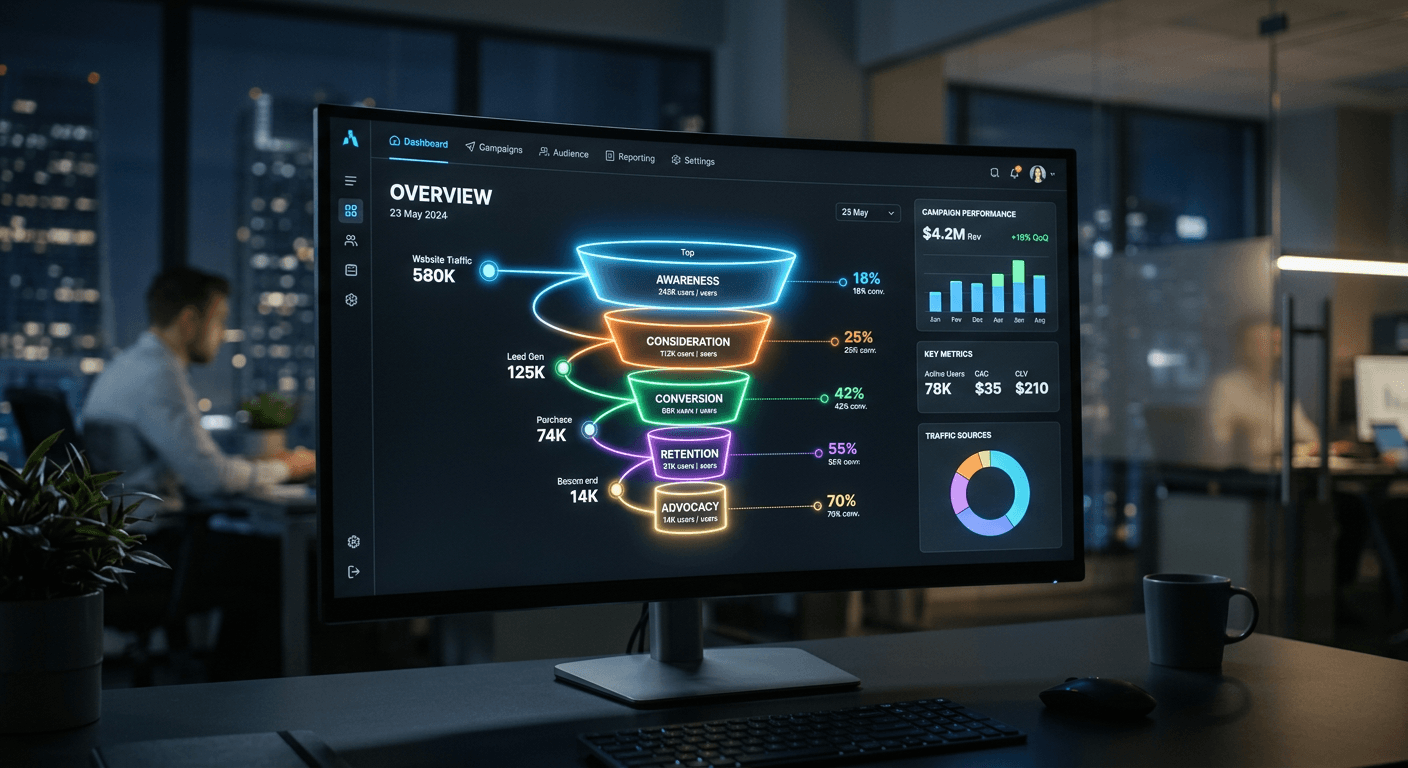
Optimizing a marketing funnel requires a transition from simple lead acquisition to a holistic strategy focused on long-term profitability. In a competitive digital landscape, capturing initial interest is only the opening act; the true measure of success lies in how effectively a business guides a prospect through a journey that results in high-value, repeat interactions. By integrating lifecycle marketing principles with data-driven adjustments, organizations can transform their engagement strategies from leaky silos into robust engines for sustainable growth.

Quick Summary
Marketing funnel optimization is the systematic process of refining each stage of the customer journey to improve conversion rates and maximize customer lifetime value (LTV). By aligning content with user intent and monitoring granular performance metrics, businesses can reduce churn and foster long-term loyalty.
- Map user behavior across the entire customer lifecycle.
- Implement feedback loops to identify and patch conversion drop-offs.
- Analyze LTV to justify acquisition costs and prioritize high-value segments.
- Apply proactive retention strategies to mitigate churn risks.
Table of Contents
- Quick Summary
- Table of Contents
- Mapping the Modern Marketing Funnel
- Analyzing LTV and Financial Impact
- Strategies for Lifecycle Marketing
- Mitigating Churn Marketing Risks
- Common Pitfalls & Troubleshooting
- FAQ
- Recommended Reads
Mapping the Modern Marketing Funnel
The traditional linear marketing funnel has evolved into a complex, multi-touch ecosystem. To effectively manage this, businesses must break down the funnel into distinct stages: awareness, consideration, conversion, and retention. Each stage requires specific content assets that address the psychological needs of the user at that exact moment. For instance, awareness content should solve a pain point, whereas conversion-oriented content must address objections and build trust through evidence.
Data mapping is the mechanism used to track movement through these stages. By assigning unique identifiers to touchpoints - such as newsletter signups, whitepaper downloads, or demo requests - you can visualize where potential customers stall. If a high volume of traffic enters the awareness stage but fails to enter consideration, the bottleneck is likely a mismatch between ad messaging and the landing page experience. Regularly auditing these gaps ensures that resources are directed toward fixing the most impactful points of friction.
Analyzing LTV and Financial Impact
Understanding what is ltv marketing provides the financial bedrock for every strategic decision. Lifetime Value (LTV) is the total projected revenue a business can expect from a single customer throughout their relationship. When you calculate this metric, you must subtract the cost of acquiring that customer (CAC). A healthy business model maintains an LTV:CAC ratio of at least 3:1. If this ratio drops, it indicates that either the acquisition costs are too high or the product is not retaining users long enough to recover the initial spend.
To increase LTV, focus on identifying the behaviors that correlate with long-term retention. Use cohort analysis to compare customers who joined at different times. If users who engage with a specific support feature or educational resource exhibit higher retention rates, build these elements into the core onboarding process for all new customers. This shift from acquisition-heavy thinking to value-maximization thinking is essential for scaling in saturated markets.
Strategies for Lifecycle Marketing
Lifecycle marketing moves beyond the initial sale to nurture the relationship at every phase of the customer's existence. This approach uses behavioral triggers - such as account inactivity, feature usage thresholds, or milestone achievements - to deliver highly relevant communication. Instead of broadcasting the same message to every user, segment your audience based on their usage patterns and provide support that helps them get more value from your offerings.
Pro Tip: Create automated email or in-app sequences triggered by specific user actions to maintain engagement without manual intervention. Personalization based on actual usage data often yields significantly higher conversion rates than demographic-based targeting.
By systematically addressing the needs of current customers through regular check-ins and personalized education, you turn existing users into brand advocates. This proactive stance not only boosts LTV but also creates a predictable stream of revenue that is less susceptible to market fluctuations.
Mitigating Churn Marketing Risks
Churn marketing is the defensive side of funnel management, aimed at identifying the early warning signs of disengagement before a customer leaves. High churn is rarely a sudden event; it is usually preceded by specific markers like reduced login frequency, unresolved support tickets, or failure to adopt key features. Tracking these metrics allows you to intervene at the 'at-risk' stage.
Implement a tiered recovery program for users showing signs of decay. This might involve personalized outreach, limited-time offers to re-engage, or deep-dive surveys to understand why the current value proposition is failing. By treating customer feedback as a diagnostic tool rather than a negative metric, you can iterate on your product or service delivery to prevent churn before it becomes irreversible.
Common Pitfalls & Troubleshooting {#common-pitfalls-&-troubleshooting}
One common error is ignoring the 'middle of the funnel'. Many organizations over-index on top-of-funnel traffic generation, leaving leads to go cold because they lack a clear path to conversion. Ensure that every lead generation effort is backed by a nurture sequence that keeps the brand top-of-mind.
Another frequent issue is data fragmentation. If your sales, marketing, and customer success teams use different metrics to define a 'qualified' lead, the funnel will be misaligned. Establish a single source of truth for conversion data. If you notice a sudden dip in conversion rates, check your tracking implementation for technical errors, such as broken tags or redirect issues that might be blocking the user journey.
FAQ
-
What is the most critical metric for long-term funnel success? While many metrics matter, LTV is the most critical because it dictates how much you can spend on acquisition and determines the long-term sustainability of the business model.
-
How can I reduce churn if my product is a commodity? Focus on the user experience and customer support. If the product itself is hard to differentiate, being the easiest and most helpful partner can significantly increase switching costs and loyalty.
-
Does lifecycle marketing require a large team? No, it relies on automation. By mapping the customer journey, you can set up workflows that trigger communications automatically based on user behavior, allowing a small team to manage thousands of relationships effectively.
-
Why is my conversion rate high but my LTV low? This usually indicates that your marketing is attracting low-quality leads or users who don't fit your ideal customer profile, often referred to as 'low-intent' traffic. You may need to refine your targeting and increase friction in the lead qualification process.