Understanding Marketing Funnels and Customer Journeys
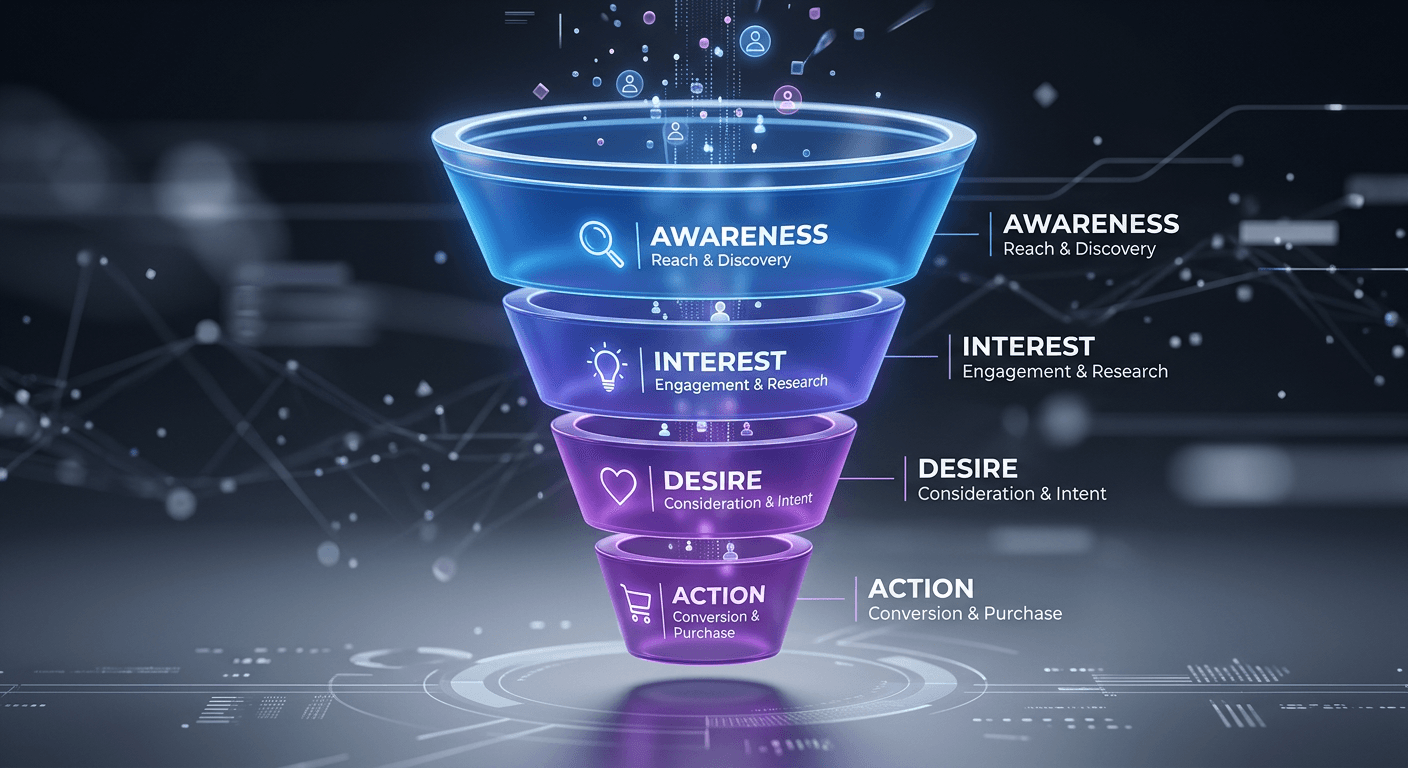
Optimizing a marketing funnel is the cornerstone of sustainable business growth, allowing brands to systematically convert strangers into loyal customers. By aligning content and messaging with the psychological state of a potential buyer, companies can minimize friction and improve return on ad spend.
Quick Summary
A marketing funnel is a strategic visual representation of the customer journey, tracing the path from initial brand awareness to final purchase. It categorizes prospects based on their engagement level, enabling tailored communication.
- Awareness: Attracting interest through educational content.
- Consideration: Nurturing a qualified lead no marketing strategy.
- Conversion: Closing the sale.
- Loyalty: Turning buyers into brand advocates.
Table of Contents
- Quick Summary
- The Anatomy of the Marketing Funnel
- Implementing the AIDA Marketing Model
- Lead No Marketing Strategies for Modern Growth
- Embracing Full Funnel Marketing
- Analyzing the Modern Customer Journey
- Comparison Table
- FAQ
- Recommended Reads

The Anatomy of the Marketing Funnel
The marketing funnel serves as a roadmap for the customer journey, breaking down the complex process of acquisition into manageable stages. At the top of the funnel (TOFU), the primary goal is mass awareness, where the volume of prospects is highest, but their intent is often low. Brands utilize broad-reach channels to capture attention, effectively widening the aperture of their audience pool.
As prospects move toward the middle of the funnel (MOFU), they transition from casual observers to active researchers. Here, the focus shifts toward relationship building and demonstrating value. By addressing specific pain points through gated content, white papers, or detailed case studies, companies can effectively identify a qualified lead no marketing effort can afford to ignore. This stage acts as a filter, separating window shoppers from individuals with a genuine need for a solution.
Finally, the bottom of the funnel (BOFU) is where the transaction occurs. Prospects at this stage have high intent and are evaluating specific product features, pricing, and social proof. Providing clear calls to action, demos, and risk-reversal offers is essential to convert these leads. For those interested in how these frameworks apply to business policies, reviewing our detailed terms of service provides insight into how professional organizations handle high-intent user interactions.
Implementing the AIDA Marketing Model
The AIDA marketing model remains one of the most durable frameworks in advertising, consisting of four distinct stages: Attention, Interest, Desire, and Action. Attention is the prerequisite for all success; without breaking through the noise, no other marketing activity matters. This requires highly relevant creative assets that resonate with a specific audience segment.
Once attention is secured, the Interest phase takes over. During this stage, the content must prove that the product or service is a viable solution to the user's problem. This is followed by the Desire stage, where brands must build an emotional or logical bridge, creating a sense of urgency or exclusivity that moves the prospect from wanting a solution to specifically wanting this solution.
Pro Tip: Do not rush the transition from Interest to Desire. Customers often abandon brands that push for a sale before they have fully established the product's unique value proposition in the customer's mind.
Lead No Marketing Strategies for Modern Growth
A qualified lead no marketing team can ignore is one that has demonstrated clear behavioral signals. Modern tracking allows marketers to move beyond demographics and focus on intent data. When a user downloads a high-value asset, visits a pricing page multiple times, or engages with a webinar, they are signaling readiness to purchase.
Developing a lead nurturing strategy is vital to ensuring that these signals are met with appropriate content. Automated email sequences or remarketing ads can bridge gaps in the customer experience. By maintaining a transparent approach to data usage, companies build trust, which is a key factor in long-term retention. To learn more about our commitment to user transparency, please review our privacy policy and its implications for data collection.
Embracing Full Funnel Marketing
Full funnel marketing is the practice of synchronizing top, middle, and bottom-of-funnel efforts under a single unified strategy. Rather than siloing brand awareness campaigns from performance marketing, the full-funnel approach ensures that the top-of-funnel content feeds naturally into the conversion stage. This creates a cohesive narrative that reduces the cost of acquisition over time.
By monitoring the entire funnel, marketers can identify where prospects are dropping off. If there is a bottleneck at the consideration stage, it suggests that the educational content is not sufficiently addressing user objections. This diagnostic capability is what separates sophisticated marketing teams from those that rely on guesswork. Implementing advanced marketing solutions often requires this holistic view to ensure that growth is not just a temporary spike but a scalable trend.
Analyzing the Modern Customer Journey
The traditional linear model of the funnel is rarely representative of the reality of modern consumer behavior. Today’s customer journey is often recursive and multi-channel. A user might discover a brand on social media, perform a Google search, visit the website via a paid ad, and finally purchase after receiving an email newsletter months later.
Marketers must embrace attribution models that account for these touchpoints. Expecting a single interaction to result in a sale is unrealistic in complex B2B or high-ticket B2C environments. Instead, focus on "touchpoint mapping" to understand the aggregate influence of your marketing ecosystem on the final conversion decision.
Comparison Table
| Funnel Stage | Objective | Primary Tactic | KPI |
|---|---|---|---|
| Awareness | Reach & Education | Paid Social / SEO | CPM / Traffic |
| Consideration | Engagement | E-books / Webinars | CTR / Lead Velocity |
| Conversion | Purchase | Product Demos | Conversion Rate |
| Loyalty | Advocacy | Referral Programs | CLV / Churn Rate |
FAQ
What is the primary difference between a marketing funnel and a customer journey?
A marketing funnel is the internal framework companies use to manage sales processes, while the customer journey is the external, lived experience of the buyer across all touchpoints.
How does the AIDA model fit into a modern digital strategy?
AIDA provides a simplified structure to audit your content assets. It helps ensure that you have materials tailored to every stage of the user's emotional and logical progression.
Why is full funnel marketing considered more efficient than focusing on bottom-funnel only?
Focusing only on the bottom of the funnel eventually exhausts your audience. Full funnel marketing builds an ongoing pipeline of new prospects, ensuring long-term sustainability.
What constitutes a 'qualified' lead in a modern funnel?
A qualified lead has both the intent to buy and the authority or budget to execute the purchase, typically verified through behavioral data and lead scoring.